
TOYOTA FIRST-EVER RAV4 PLUG-IN HYBRID TO ARRIVE IN DEALERSHIPS IN LATE JUNE
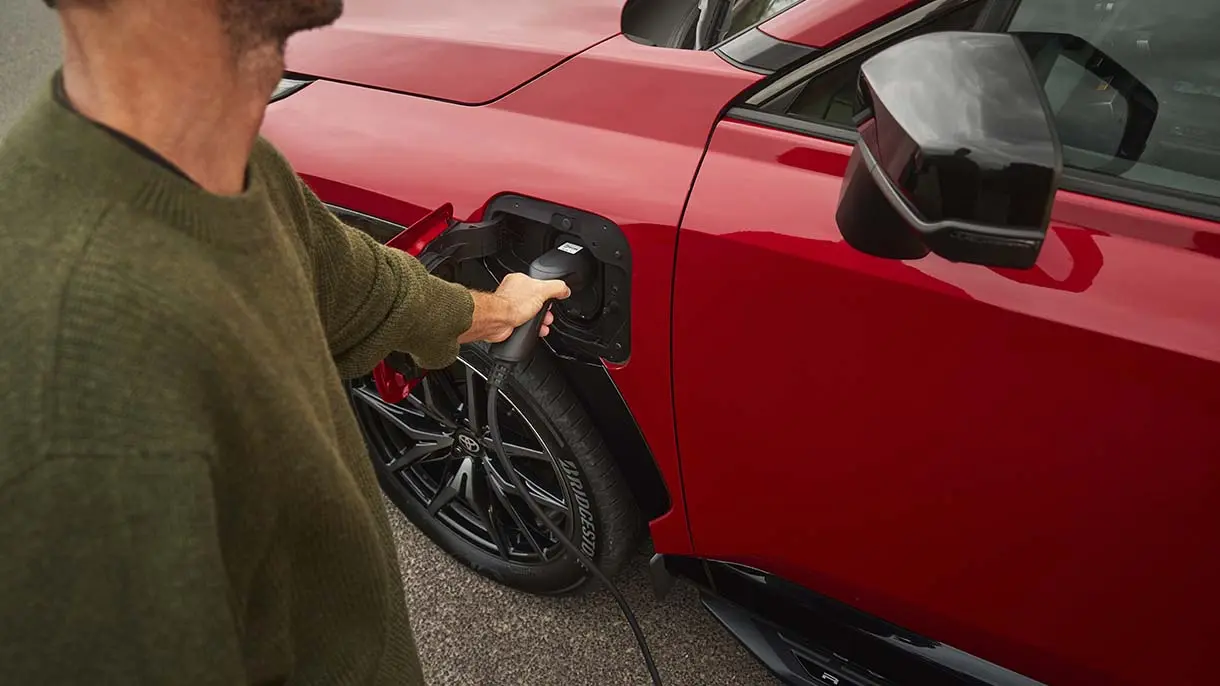

Toyota’s first ever plug-in hybrid (PHEV) vehicle for Australia will go on sale in late
June when the RAV4 PHEV arrives in dealerships priced from $58,8401.
The all-new sixth-generation RAV4 PHEV powertrain will be offered in three
variants with a RAV4 XSE in 2WD and AWD, along with the all-new range-topping
RAV4 GR Sport AWD.
Toyota Australia Vice President Sales, Marketing and Franchise Operations John
Pappas said this was a milestone moment for Toyota as it continued to expand its
multi-pathway approach to decarbonisation and offer Australian customers a broad
choice of powertrains that suit the vehicle and customer use.
“The arrival of our first plug-in hybrid model further expands our multi-pathway
strategy that aims to provide the right powertrain for the right vehicle and its
intended use,” Mr Pappas said.
“While we are continuing to expand our battery electric range with the arrival of the
bZ4X Touring model, we have always said that BEVs are only one part of a
broader mix of solutions to reducing emissions, as our vehicles have to be fit for
purpose.
“That means continuing to offer customers a mix of hybrid, BEV, PHEV, diesel,
petrol and FCEV (fuel-cell electric vehicles) powertrains while always looking to
ways to improve efficiency, performance and reduce CO2 tailpipe emissions.
“For RAV4, we have already launched the extremely efficient all-new
sixth-generation model in hybrid versions and the new PHEV models will provide
greater performance for those who really enjoy their driving out on the open road,
along with the ability to run on electric power alone for shorter trips around the
city,” he said.
The RAV4 XSE 2WD PHEV uses Toyota’s sixth generation plug-in hybrid
powertrain that combines a 2.5-litre four-cylinder petrol engine with a front electric
motor generator that deliver a combined maximum power output of 201kW.
AWD versions of the plug-in hybrid RAV4 models add a second electric motor
generator on the rear axle and offer a combined maximum output of 227kW,
making the XSE AWD and GR Sport AWD versions the most powerful RAV4s
ever.
A large-capacity 22.7kWh lithium-ion battery pack provides ample EV-only driving
range for shorter trips and supports both 50kW DC charging and 11kW
three-phase AC charging.
For 2WD variants, the new RAV4 PHEV offers up to 154km of EV-only driving
based on the NEDC test cycle (121km on WLTP) with AWD versions including the
new GR Sport providing up to 144km of electric-only range based on NEDC
testing (113km on WLTP)2.
RAV4 XSE PHEV versions share the same high level of premium features with
their hybrid counterparts with addition of larger disc brakes and a handy 1500W
inverter with a three-pin plug in the luggage space capable of powering small
appliances.
The RAV4 GR Sport sits on a 20mm wider track and front performance dampers,
a rear brace, and unique spring and damper rates and steering tune to provide a
sportier drive experience.
The mechanical enhancements are complemented by a range of modifications to
further improve aerodynamics and provide a sporty aesthetic, inside and out.
1 Manufacturer's recommended retail price provided for media purposes only. Statutory charges or other on-road costs not included. 2 Results were achieved under test conditions and do not reflect the driving range in real world driving. [154km - 2WD / 144km – AWD] range, achieved for Australian plug-in hybrid RAV4 PHEV 2WD and RAV4 PHEV AWD automatic SUV variants, is based on consumption rate of 184 (2WD variants) and 191 (AWD variants) Wh/km using the New European Driving Cycle (NEDC) laboratory test [combined drive cycle] mandated by the ADR 81/02 (displayed on the Energy Consumption label affixed to the car). Results were achieved under test conditions and do not reflect the driving range in real world driving. 121km (2WD) and 113km (AWD) range, achieved for [European] battery electric RAV4 PHEV 2WD and RAV4 PHEV AWD automatic SUV variants, is based on consumption rate of 184 (2WD variants) and 191 (AWD variants) Wh/km using the Worldwide Harmonised Light Vehicle Test Procedure (WLTP). Australian model has not been tested using WLTP test procedure but would be expected to have similar results under WLTP test
conditions.